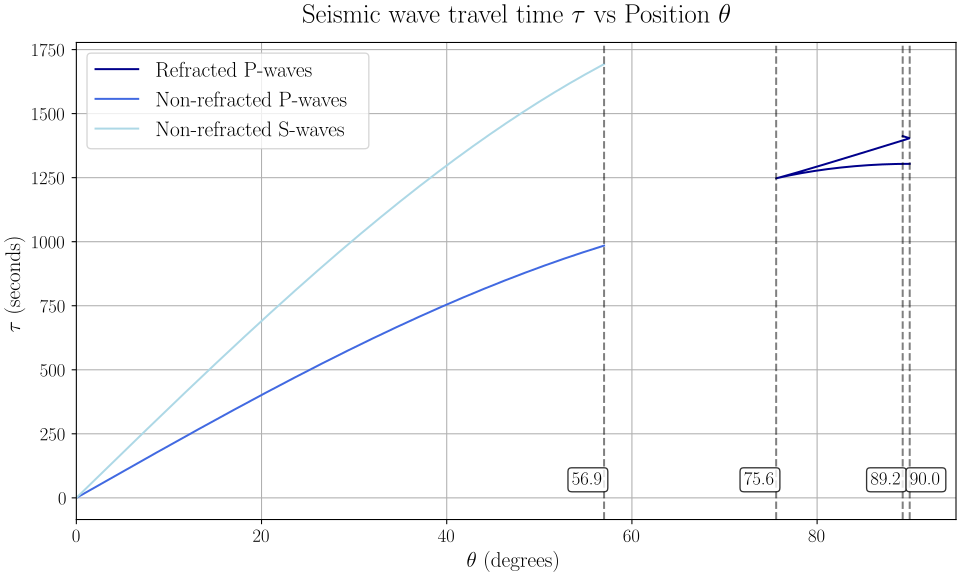
For the non-refracted waves, the cutoff angle is $\arccos{(R_C/R)}=56.9^\circ$. For both types of waves, the travel time is computed using
$$ \tau = \frac{2R\sin{\theta}}{v}. $$
For the refracted waves, the incidence angle at the core $i$ can range from $0$ to $\pi/2$. Each angle $i$ matches to a certain position $\theta$ via
$$\theta = \frac{\pi}{2} + i - \arcsin{\left(\frac{v_{CP}}{v_P}\sin{i}\right)} - \arcsin{\left(\frac{R_C}{R}\sin{i}\right)} $$
One can find that the minimum $\theta$ is $75.6^\circ$ and the maximum $\theta$ is $90.8^\circ$. The angles $\theta > 90^\circ$ correspond to rays that travel around more than half the Earth. Counting angles from the opposite direction, we see that they can be described by $180^\circ - \theta$ instead of $\theta$.
Each angle $i$ also gives us a travel time
$$\small \tau = 2\left(\frac{1}{v_P}\sqrt{R^2+R_C^2-2RR_C\cos{\left(i-\arcsin{\left(\frac{R_C}{R}\sin{i}\right)}\right)}} + \frac{1}{v_{CP}}\sqrt{R_C^2-R_C^2\left(\frac{v_{CP}}{v_P}\sin{i}\right)^2} \right).$$
Between $75.6^\circ$ and $90^\circ$, there are multiple $i$ that result in a given $\theta$. This means that the graph of $\tau$ against $\theta$ has multiple branches – either two, or in the case of the "backfolded" $\theta>90^\circ$ – three.